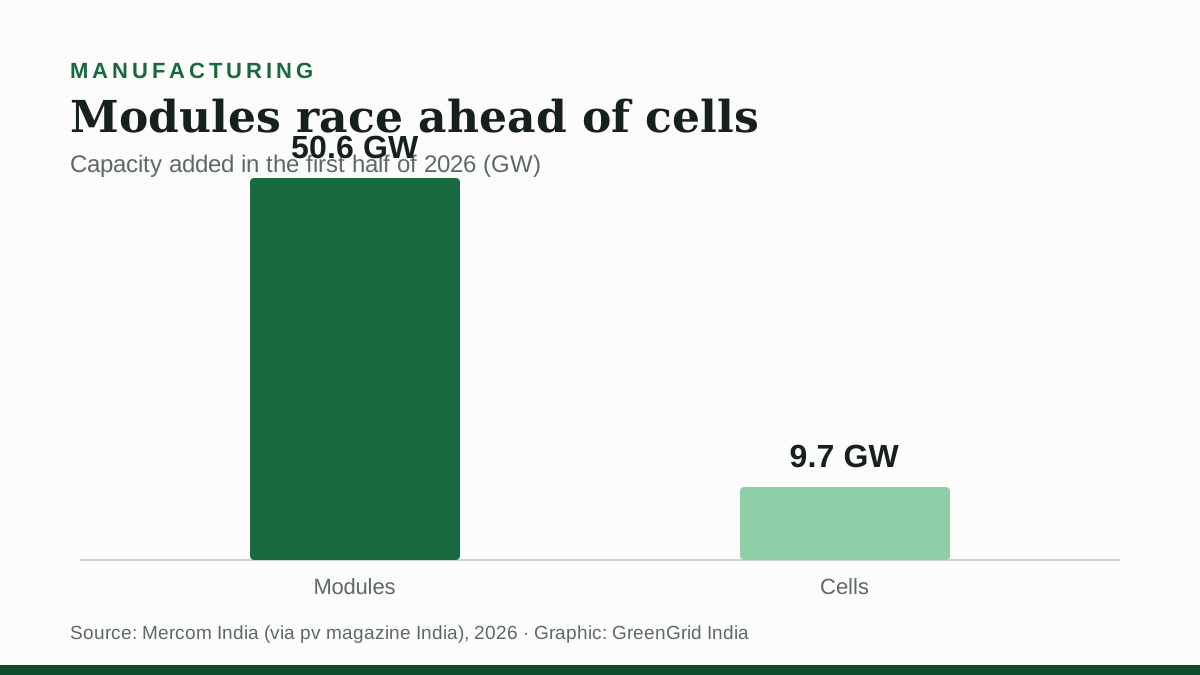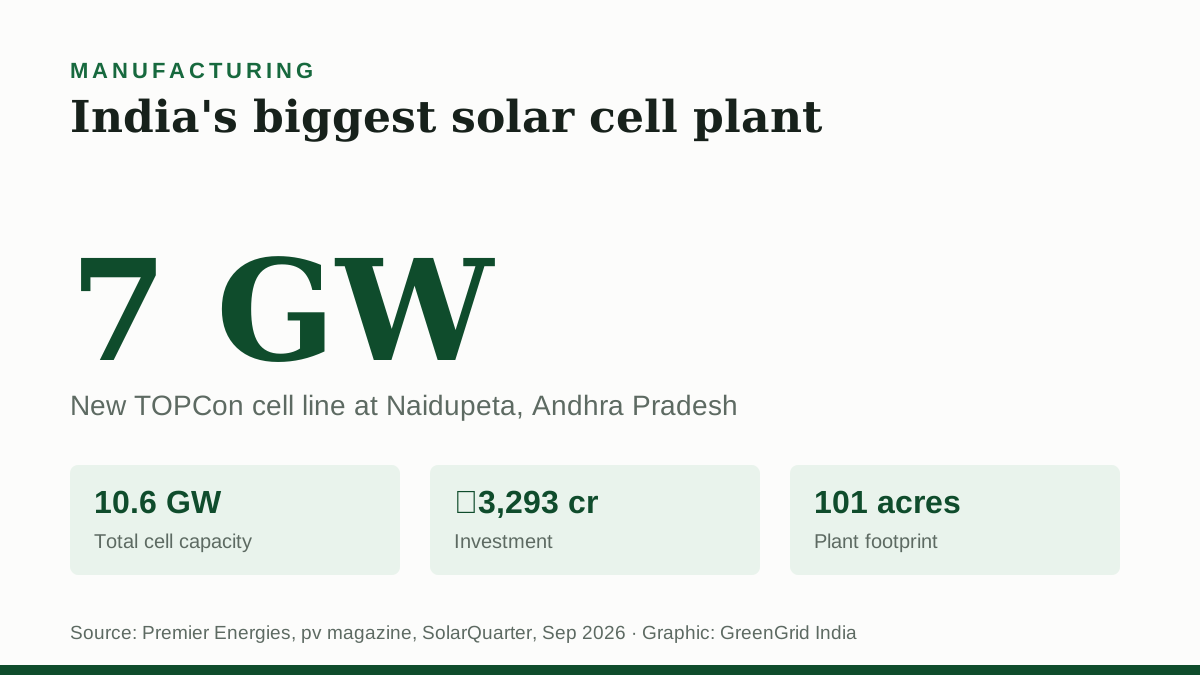
India can make plenty of solar modules; making the cells that go inside them has been the harder problem. Premier Energies has just moved the needle, commissioning what is billed as India’s largest solar cell plant — a 7 GW n-type TOPCon facility at Naidupeta, Andhra Pradesh.
The new line, which has begun trial production, lifts the company’s total solar cell manufacturing capacity to 10.6 GW, making Premier Energies the country’s largest cell maker by capacity. The plant was built for around ₹3,293 crore on a 101-acre site.
Cells are the bottleneck
The distinction between modules and cells matters. India’s module assembly capacity has ballooned past 100 GW, but cell capacity has lagged far behind, leaving manufacturers dependent on imported cells — mostly from China — even for “Made in India” panels. A CEEW study earlier in 2026 pegged total domestic cell capacity at about 29.66 GW, of which the newer TOPCon technology accounted for roughly 8.5 GW, with much more in the pipeline.
By adding 7 GW of TOPCon cells in a single step, Premier Energies narrows that gap and positions itself for the stricter domestic-content rules now coming into force, including the government’s ALMM List-II mandate for locally made cells.
Building out the stack
The cell plant caps a busy year for the company. In January 2026 it added a 400 MW PERC cell line that took cell capacity from 3.2 GW to 3.6 GW, and in July it inaugurated a 5.6 GW module facility that pushed module capacity to 11.1 GW. The through-line is vertical integration — owning more of the wafer-to-module chain rather than importing the high-value middle of it.
For India’s solar manufacturing ambitions, deeper cell capacity is exactly the kind of investment that turns assembly lines into a genuine supply chain.
This article is based on company announcements and public reporting; figures are as reported by the company and trade press.