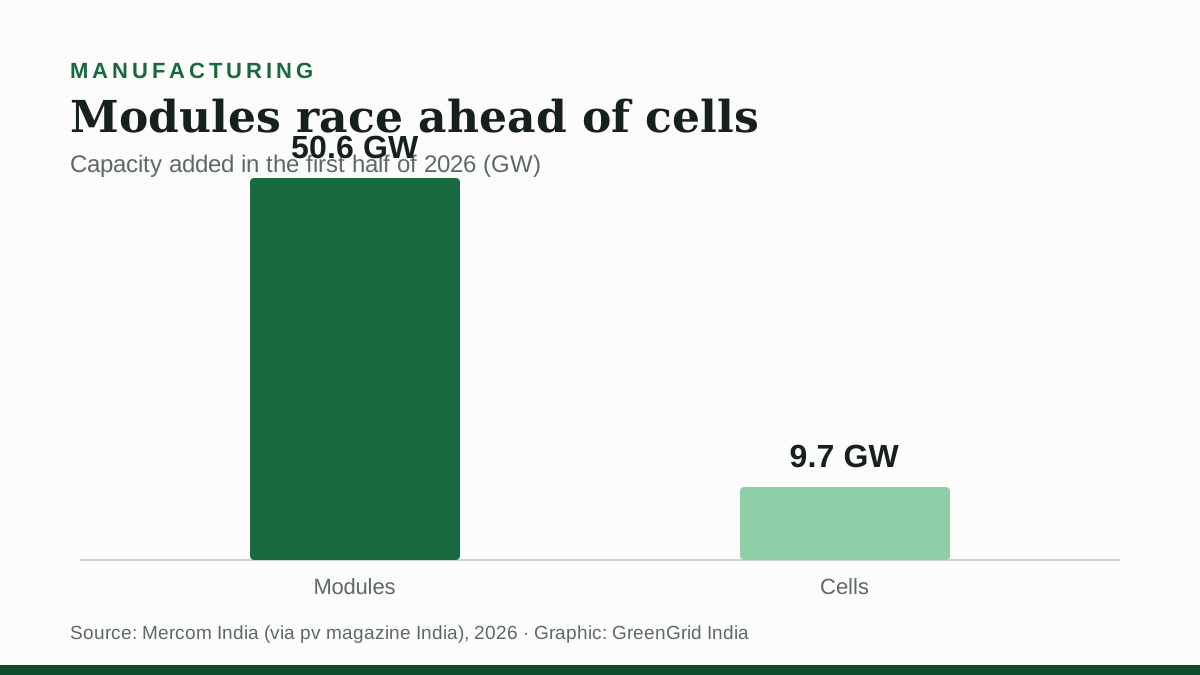
India’s solar factories are multiplying — but unevenly. According to Mercom India Research, the country added 50.6 GW of solar module manufacturing capacity in the first half of 2026, alongside just 9.7 GW of solar cell capacity. The five-to-one ratio captures, in a single data point, the structural imbalance that still defines Indian solar manufacturing.
The module–cell gap
Modules are the easy part. Assembling cells, glass, encapsulant and frames into a finished panel is comparatively low-tech and quick to scale, which is why India’s module capacity has raced past 100 GW. Cells — the light-absorbing heart of a panel — require far more capital, cleaner processes and tighter know-how, so capacity has grown much more slowly.
The consequence is a supply chain that can stamp out panels but still imports a large share of the cells inside them, predominantly from China. That dependency is precisely what the government’s ALMM List-II mandate, which requires domestically made cells in many project categories, is designed to squeeze out over time.
Closing the gap, slowly
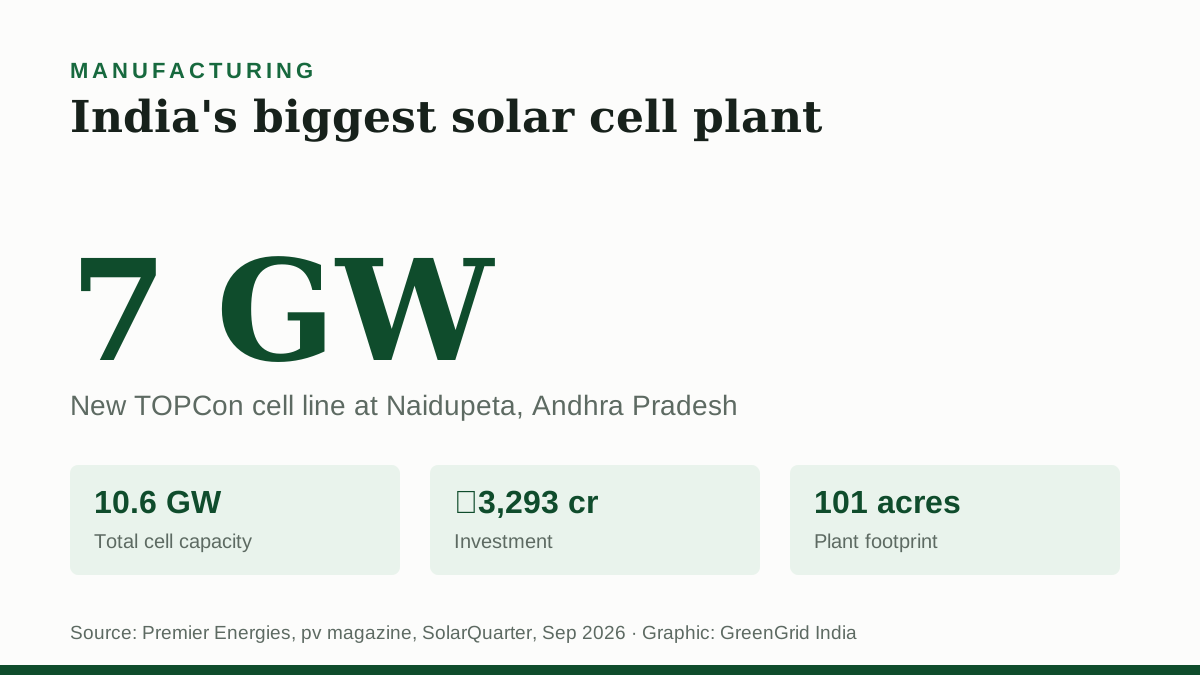
The 1H 2026 additions show the direction of travel: cell capacity is finally being built, just not yet fast enough to match module output. Large new lines — including gigawatt-scale TOPCon cell plants commissioned later in the year — should narrow the ratio, and incentives under the production-linked schemes continue to pull investment toward the upstream end of the chain.
For now, India’s manufacturing story remains two-speed. The country is well on its way to module self-sufficiency, but true supply-chain independence depends on the harder, slower work of building cells, wafers and the polysilicon behind them.
This article is based on data published by Mercom India via pv magazine India.