For years, rooftop solar was the segment that underdelivered in India — a market with enormous theoretical potential that never quite took off against the pull of cheap utility-scale power. The first half of 2026 suggests that has changed.
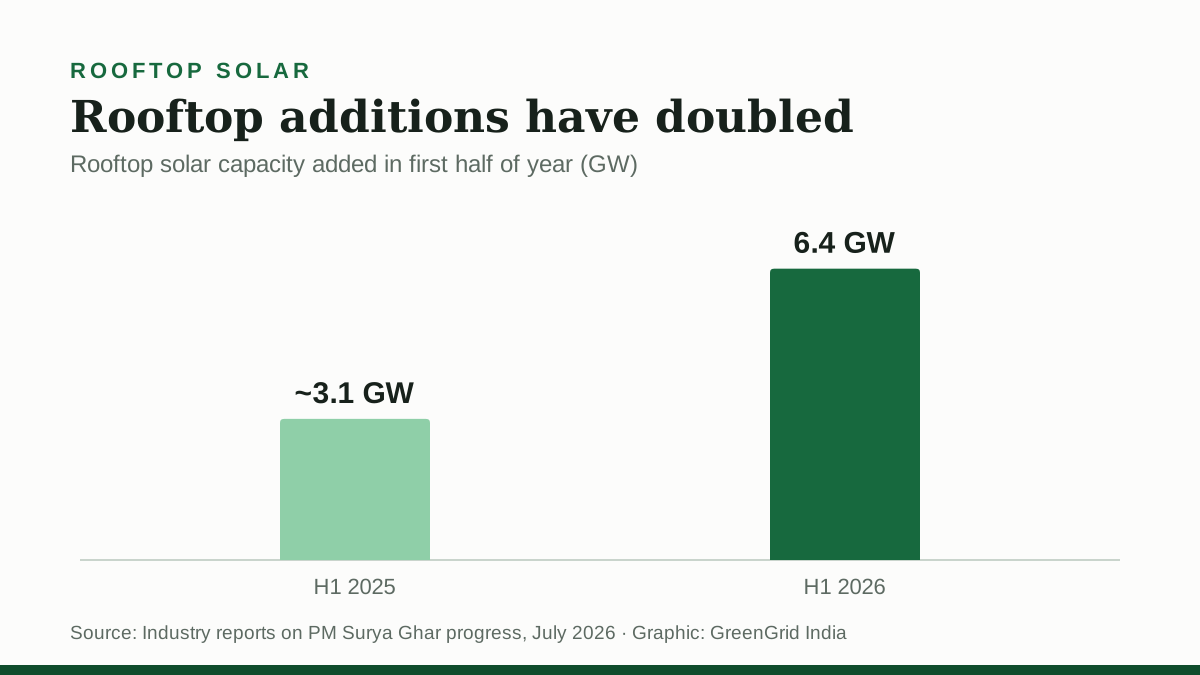
India installed around 6.4 GW of rooftop solar between January and June 2026, a 104% increase over the roughly 3.1 GW added in the same period last year. Rooftop was the fastest-growing segment of the market, contributing nearly a quarter of all solar capacity added in the half.
What changed
The obvious answer is PM Surya Ghar: Muft Bijli Yojana, the residential rooftop subsidy scheme that pairs central financial assistance with up to 300 units of free electricity a month for participating households. The scheme has done three things at once:
- Cut the payback period for a typical residential system to just a few years in most states;
- Standardised the process — vendor registration, net metering and subsidy disbursal now run through a single national portal;
- Built installer capacity, with a wave of new rooftop businesses registered across tier-2 and tier-3 cities.
Commercial and industrial (C&I) rooftops have added their own momentum, as businesses lock in power costs and chase renewable energy targets.
The caveats
Growth is uneven. A handful of states — Gujarat foremost among them — account for a disproportionate share of residential installations, while several large states are barely getting started. Discom finances remain a friction point: net-metering rules and connection timelines still vary widely, and installer quality is uneven in a market growing this fast.
Still, the direction of travel is unambiguous. If the second half of 2026 matches the first, India’s rooftops will add more capacity this year than the entire country added from all solar sources in some recent years — and the distributed side of the energy transition will finally be pulling its weight.