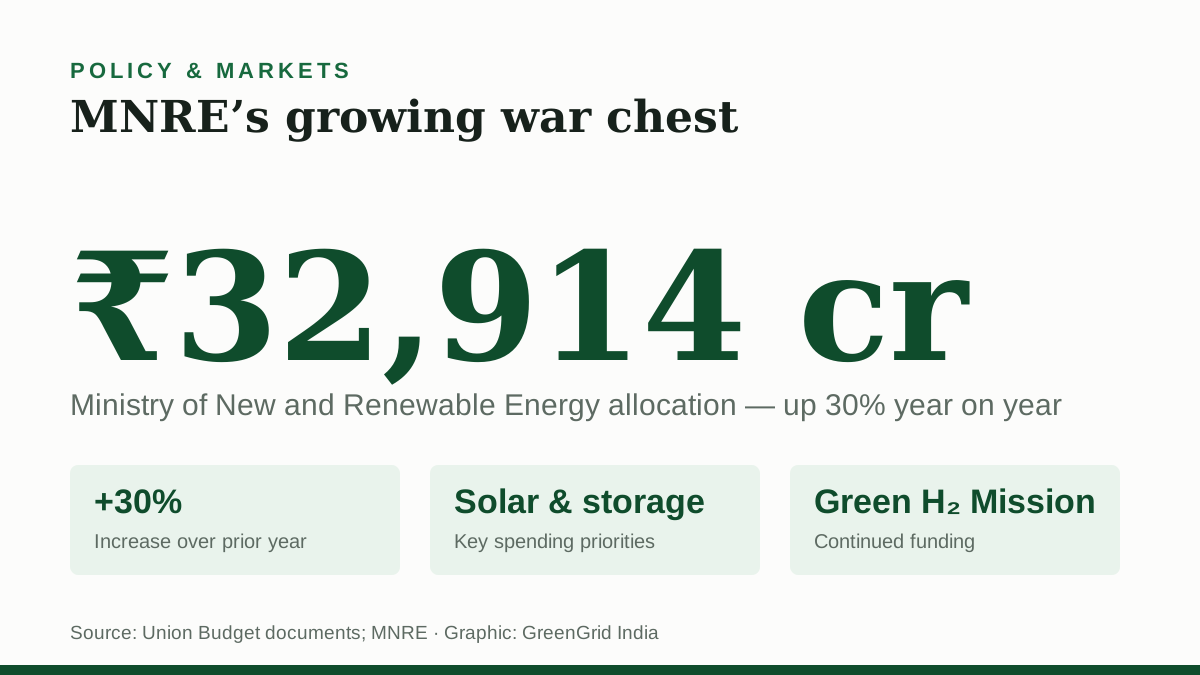
Budgets are where policy intentions become measurable, and the Ministry of New and Renewable Energy’s latest allocation says plenty: ₹32,914 crore, an increase of roughly 30% over the prior year.
The money is pointed at four priorities:
- Solar schemes — with PM Surya Ghar’s rooftop subsidies the single biggest consumer of funds as installation volumes double;
- Grid-scale storage — viability gap funding for battery energy storage systems, the instrument behind much of the current BESS construction boom;
- Green energy corridors — the transmission build-out that renewable-rich states need to evacuate power;
- The National Green Hydrogen Mission — continued funding for electrolyser and production incentives plus the new industrial pilot rounds.
Reading the tea leaves
Three observations on what the numbers imply.
Rooftop is the political flagship. The scale of PM Surya Ghar’s claim on the budget reflects a scheme that is both popular and, on H1 2026 evidence, actually delivering capacity. Expect it to keep growing.
Storage has moved into the core. VGF for batteries sat at the margins of earlier budgets. Its expansion tracks the sector’s shift from tendering experiments to critical grid infrastructure — India’s operational BESS fleet grew eleven-fold in the past six months.
Transmission remains the quiet constraint. Corridor funding is less headline-friendly than gigawatt announcements, but developers consistently rank connectivity and evacuation as the sector’s binding constraint. A 30% larger budget helps; execution speed matters more.
As always, allocation is not disbursal — under-spending has dogged some schemes in past years — but as a statement of direction, the 2026–27 numbers are the clearest yet: the government intends to keep its foot on the accelerator through the back half of the decade.