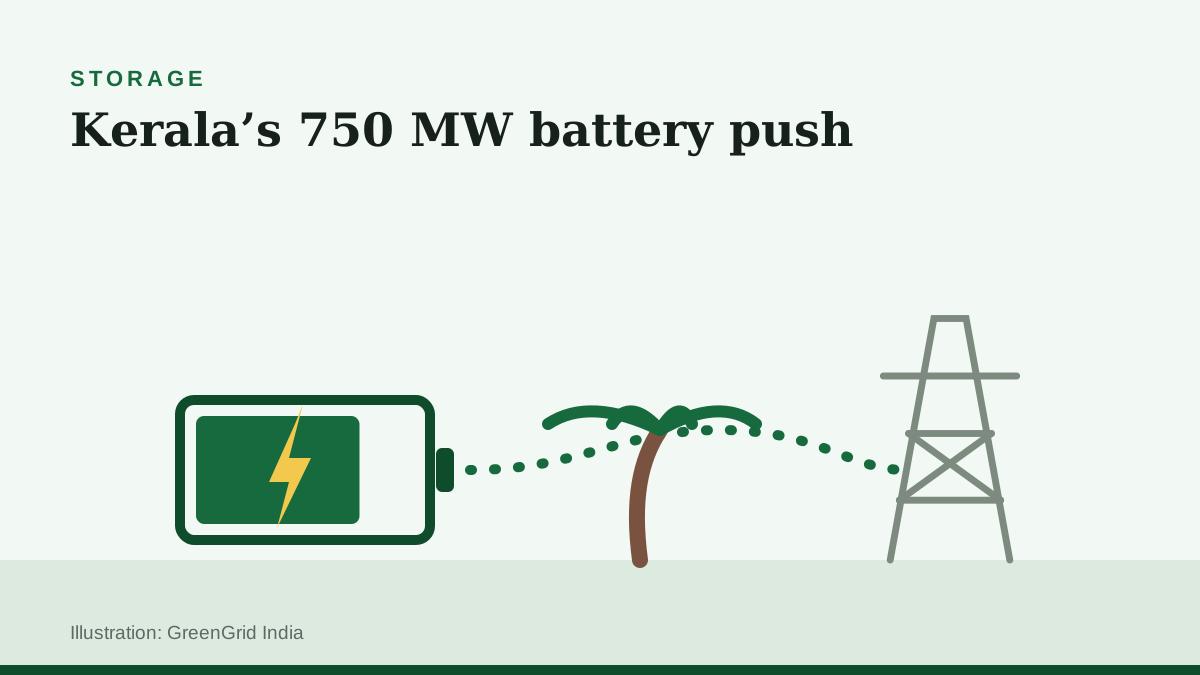
Most of India’s storage headlines come from the sun-soaked west. One of the more interesting deployments, though, is happening in a state with modest solar parks and a very different problem: Kerala is accelerating the rollout of 750 MW of battery energy storage to strengthen grid stability and absorb more renewable power.
Kerala’s particular arithmetic
Kerala imports a large share of its electricity from the national grid, leans on ageing hydro for flexibility, and faces one of the country’s most pronounced evening peaks — a domestic-consumption-driven surge that arrives just as solar generation, local and imported, disappears. The state’s options are limited: land for large solar parks is scarce and expensive, new hydro is slow and contentious, and firm imports at peak hours are increasingly costly.
Batteries fit that gap almost exactly. Charged with cheap midday solar — increasingly from rooftops, where Kerala’s dense housing stock is well suited to PM Surya Ghar — a distributed BESS fleet can shave the evening peak, defer transmission upgrades and give the state operator a fast-responding reserve.
Part of a wider southern pattern
Kerala’s push mirrors moves across the southern grid: Tamil Nadu and Karnataka have their own storage tenders, and the region’s high renewable penetration makes it the natural laboratory for India’s storage-heavy operating model. Nationally, some 10 GW of BESS is under construction with roughly twice that in tendering — the 750 MW programme puts Kerala firmly on that map.
Execution details — sites, tranches, commissioning timelines — will determine how quickly the megawatts become real. But the strategic read is straightforward: in the states where land is the binding constraint, the energy transition will be won with wires and batteries rather than parks. Kerala is betting on exactly that.