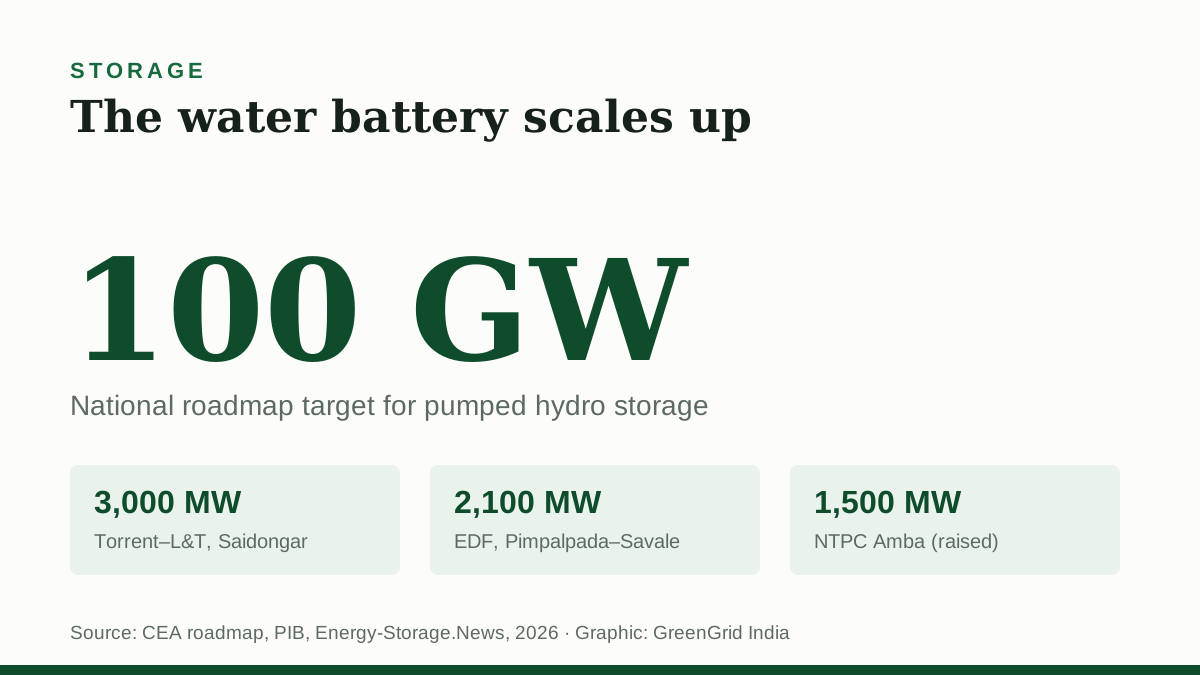
Batteries dominate India’s storage headlines, but for firming the grid over many hours — and many decades — the country is placing a large bet on an old technology: pumped storage hydropower (PSP). The Central Electricity Authority has laid out a roadmap toward roughly 100 GW of pumped storage, positioning the “water battery” as the backbone of long-duration storage as variable renewables take over the generation mix.
A pumped storage plant works like a rechargeable battery made of water: cheap surplus power (increasingly midday solar) pumps water uphill to an upper reservoir, and the water is released through turbines to generate electricity when demand peaks. Unlike lithium batteries, PSPs can discharge for many hours and last 40 years or more.
A wave of projects
The pipeline is filling fast, with Maharashtra at the centre:
- NTPC and the Maharashtra government signed an addendum in April 2026 raising the Amba PSP from 800 MW to 1,500 MW and the Kumbhe PSP from 1,000 MW to 1,100 MW.
- Torrent Power picked L&T to build the 3,000 MW Saidongar-1 project — among India’s largest — using ten 300 MW reversible pump-turbines.
- EDF’s India arm signed on for the 2,100 MW Pimpalpada–Savale project, a roughly ₹10,217 crore investment.
- ONGC Green and NHPC signed an MoU in June 2026 to jointly develop pumped hydro.
The catch
Pumped storage is not a quick fix. Projects take years to permit and build, depend on suitable topography and water, and carry real environmental and land sensitivities. Translating a 100 GW roadmap and a stack of MoUs into commissioned capacity is the hard part — and the timelines stretch well into the 2030s.
Still, the direction is clear: as India’s grid fills with solar and wind, long-duration storage is moving from afterthought to necessity.
This article is based on the CEA roadmap, a PIB release, and public reporting; some targets and timelines vary by source.