India’s battery storage market spent 2025 in a race to the bottom on price. Through 2026, that race has reversed — and the correction may be healthy.
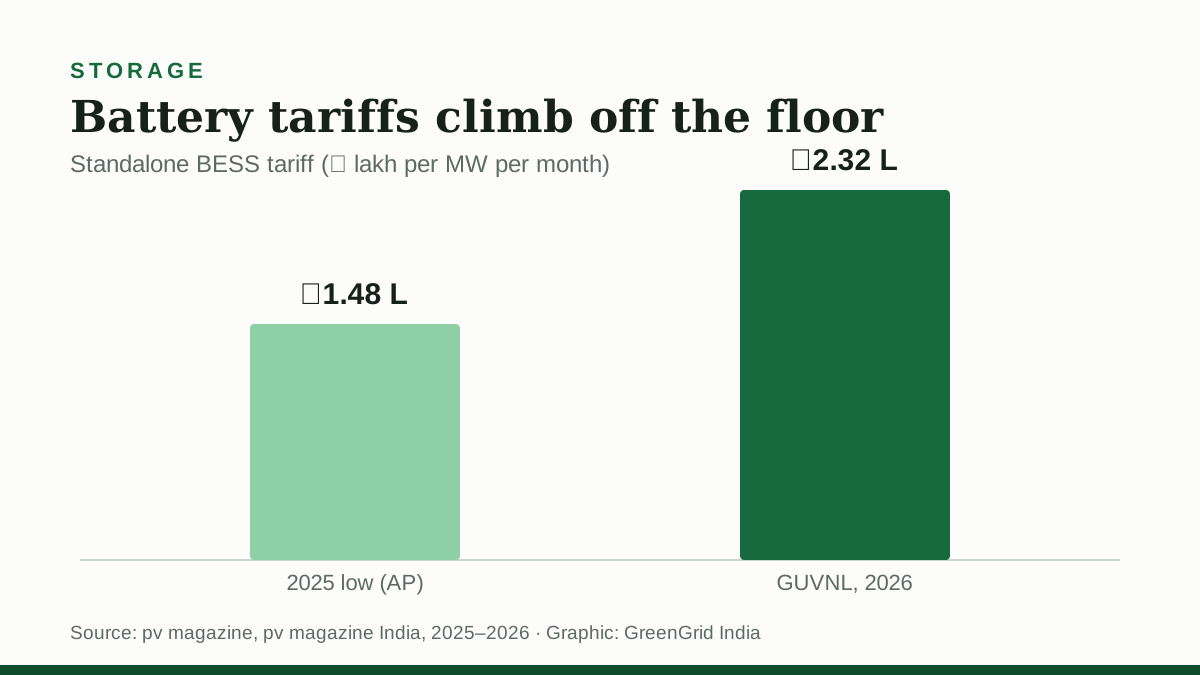
Standalone battery energy storage system (BESS) tariffs hit historic lows late last year, bottoming near ₹1.48 lakh per MW per month in an Andhra Pradesh auction in December 2025. By mid-2026 the numbers had firmed: Gujarat’s GUVNL concluded its Phase IX tender for 450 MW/900 MWh at a lowest discovered tariff of around ₹2.32 lakh per MW per month in August, supported by viability gap funding.
Cheap, but bankable?
The 2025 lows set records but raised alarms. Analysts at JMK Research and IEEFA flagged that a large share of the two-hour capacity awarded at rock-bottom tariffs sits in an “at-risk” category — bids so aggressive that, against rising cell costs and financing rates, the projects may struggle to be built or financed. Business Today and others documented the same concern: a record-low tariff is only a good deal if the battery actually gets delivered.
Seen that way, 2026’s firmer pricing looks less like a setback and more like the market finding a sustainable floor. GUVNL’s ₹2.32 lakh clearing price sits close to the roughly ₹2.3 lakh/MW/month benchmark analysts consider realistic for two-hour systems.
Different formats, different numbers
Comparisons are tricky because tenders are structured differently. Capacity-based auctions quote ₹/MW/month, while some four-hour tenders — such as a recent UPPCL award — are priced on energy delivered, at around ₹6.45–6.46/kWh. The headline figures are not directly comparable, which is part of why “record low” claims should be read carefully.
The through-line is that storage is now central to India’s grid plans — and the market is maturing past the point where the lowest bid automatically wins the headline.
This article is based on auction results and analysis reported by pv magazine and Business Today.