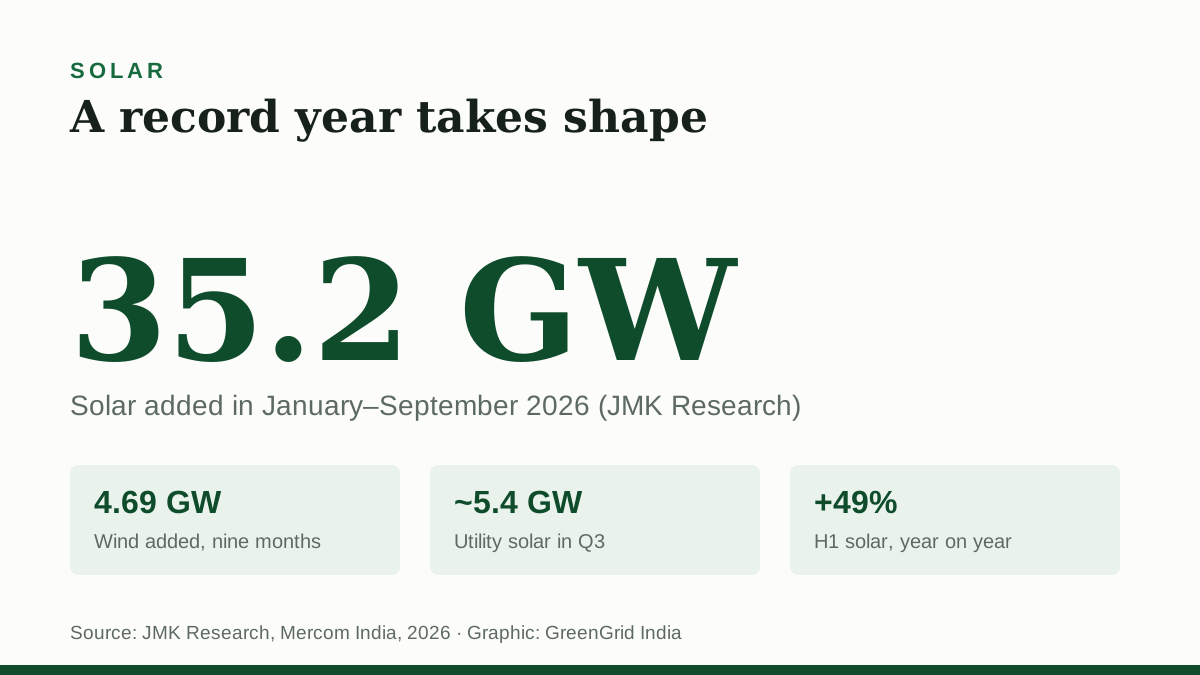
India’s clean power build-out is running at a pace that would have looked implausible a few years ago. According to JMK Research & Analytics, the country added roughly 35.2 GW of solar and 4.69 GW of wind in the first nine months of calendar 2026 — a haul that, with a quarter still to go, already eclipses most full years on record.
The solar figure is the headline. Mercom India’s separate market update put first-half solar additions at a record 27 GW, up about 49% year on year from 18 GW, with the second quarter alone contributing nearly 12 GW — the second-highest quarterly total the country has logged. (The two research houses use different methodologies and reporting periods, so their numbers are best read as directional rather than directly additive.)
The shape of the year
The momentum has not been perfectly even. JMK’s data suggests utility-scale solar eased from about 6.87 GW in the second quarter to roughly 5.4 GW in the third, a reminder that module supply, land, transmission connectivity and evacuation constraints still throttle how fast projects reach the grid. Wind remains the smaller story in absolute terms, though it has shown signs of life, with a meaningful share of the nine-month total installed in the third quarter.
Why it matters
India is chasing 500 GW of non-fossil capacity by 2030, and the arithmetic only works if annual additions stay in the 40–50 GW range or higher. A nine-month solar tally above 35 GW signals that the top of that range is now within reach — provided the fourth quarter holds up and storage and transmission keep pace with the panels going into the ground.
If the current run rate continues, 2026 is on track to be India’s biggest-ever year for renewable capacity additions.
This article is based on data published by JMK Research and Mercom India; GreenGrid India will update when full-year figures are released.