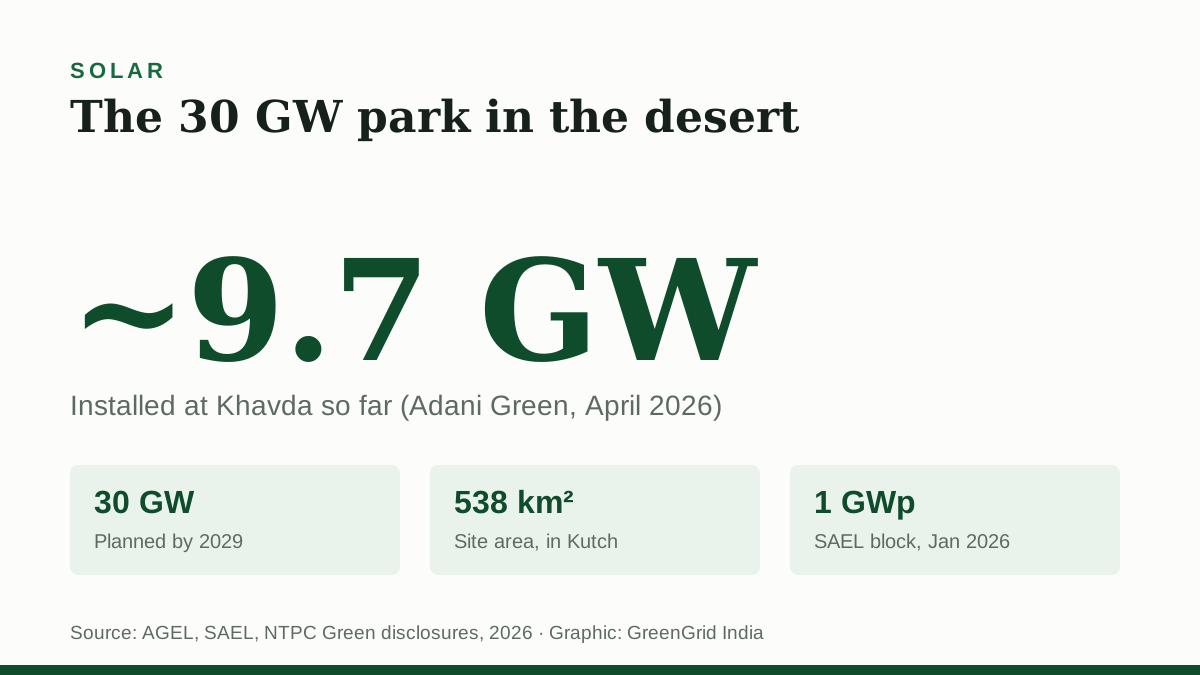
In the salt flats of Kutch, near the India–Pakistan border, the single largest piece of India’s energy transition is taking physical shape. The Khavda Renewable Energy Park in Gujarat is planned to reach 30 GW by 2029 across roughly 538 square kilometres of otherwise barren desert — a footprint several times the size of a major city, and enough capacity to rival entire national grids.
Adani Green Energy (AGEL), the park’s anchor developer, had installed a cumulative 9.7 GW at the site as of April 2026 and has kept adding blocks through the year, including a 139 MW project that began commercial operation on 1 September 2026 and a 292 MW block earlier in the spring.
Not a one-company show
Khavda is increasingly a shared build-out. SAEL Industries commissioned a 1 GWp (around 800 MW AC) plant at the park in January 2026, and NTPC Green Energy is constructing its own 1.25 GW Khavda-II solar project in phases, having energised an initial 165 MW block in February. The clustering matters: a common site lets developers share land, transmission and construction logistics at a scale no single project could justify.
Why it matters
Khavda is a test of whether India can deploy renewables at genuinely industrial scale — and of whether the grid can absorb the output. The surrounding challenge is evacuation: moving tens of gigawatts of variable power out of a remote corner of Gujarat requires a transmission build-out running in parallel with the panels and turbines. The park also leans heavily on storage and hybridisation to firm its output.
If Khavda is completed as planned, it will stand as the largest renewable energy installation on the planet — a symbol of the sheer physical ambition behind India’s 500 GW target.
This article is based on company disclosures and public reporting; capacity figures vary by source and reporting date.