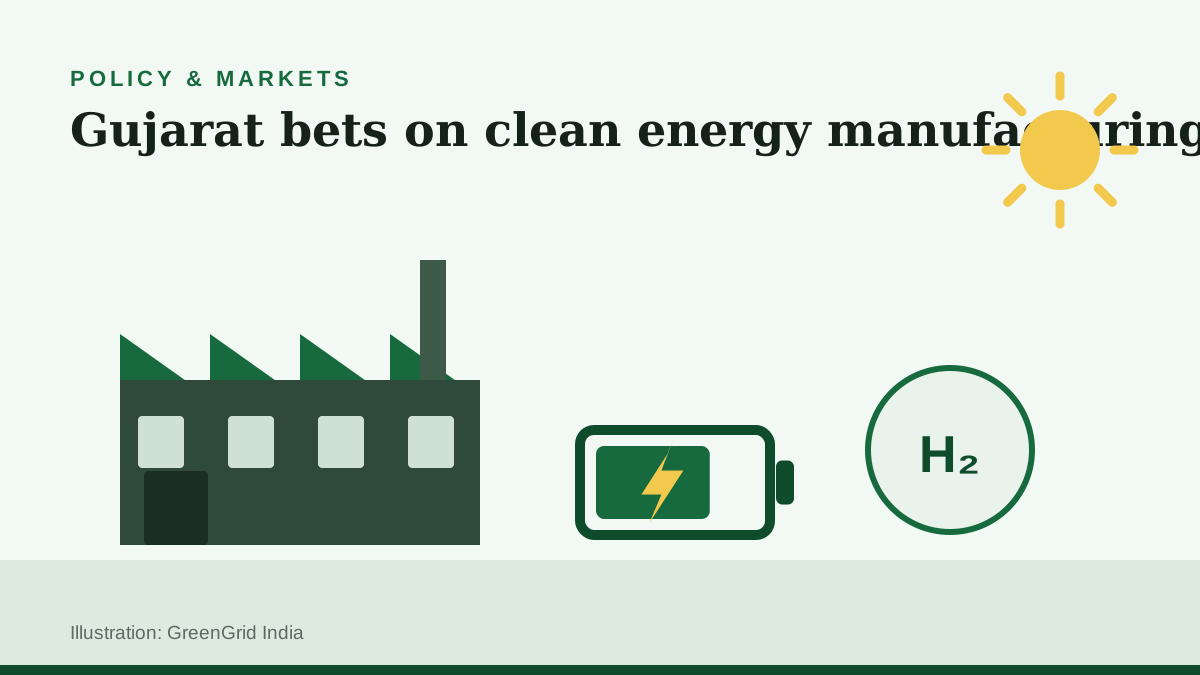
Gujarat already leads India in installed renewable capacity and led all states in H1 2026 solar additions. Its new industrial policy makes clear the next ambition: to manufacture the equipment the energy transition runs on, not merely host the projects.
The policy identifies renewable energy equipment manufacturing, battery storage, green hydrogen and nuclear power equipment as priority sectors, according to reporting on the policy — putting clean-tech hardware alongside the state’s traditional industrial strengths in chemicals, engineering and textiles.
The logic
Gujarat’s pitch to manufacturers stacks several advantages:
- Demand next door. The state’s own pipeline — solar parks, the hybrid mega-park at Khavda, storage tenders and a nascent hydrogen hub ambition — gives factories a local order book.
- Ports and export lanes. Mundra and Kandla make Gujarat the natural base for module and component exports, which have become a meaningful revenue line for Indian manufacturers selling into the US and other markets.
- Existing ecosystem. Several of India’s largest module and cell plants already operate in the state, pulling suppliers of glass, encapsulants, frames and trackers to co-locate.
Incentives in the policy run along familiar lines — capital subsidies, power tariff concessions and land facilitation for anchor units — with sweeteners scaled for the priority sectors.
The competition
Gujarat is not alone. Madhya Pradesh is filling its Mohasa-Babai renewable equipment zone (see our Navurja story this week), Tamil Nadu anchors southern cell and module capacity, and Rajasthan, Maharashtra and Uttar Pradesh have their own clean-tech carve-outs. The inter-state race that once played out over auto plants is now running over gigafactories.
That competition is largely good news for the sector: it compresses timelines, discounts land and power, and gives manufacturers negotiating leverage. The open question is whether demand — domestic and export — grows fast enough to absorb everything the states are collectively courting.