India’s grid planners want the next wave of renewable capacity to come with its own shock absorbers. The Central Electricity Authority (CEA) has published a draft amendment that would, for the first time, require large new solar and wind projects to build energy storage alongside them — a shift from treating storage as an optional add-on to writing it into the construction standard itself.
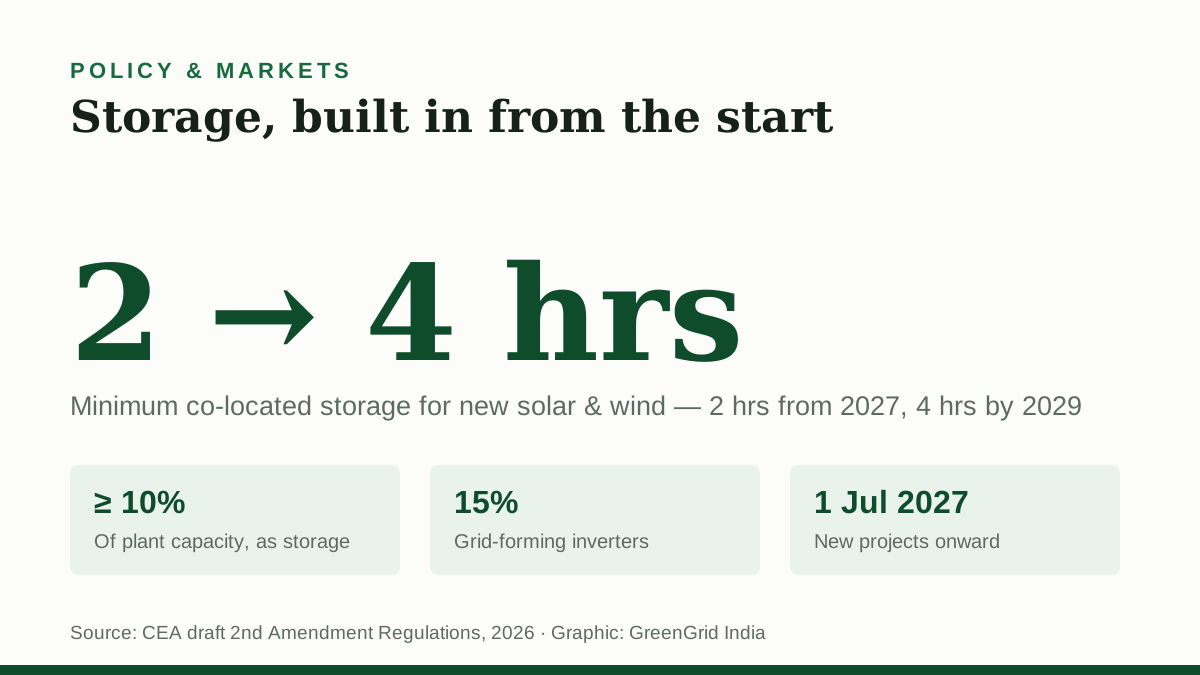
Under the draft Central Electricity Authority (Technical Standards for Construction of Electric Plants and Electric Lines) 2nd Amendment Regulations, 2026, ground-mounted solar and onshore wind projects commissioned after 1 July 2027 would have to install co-located energy storage equal to at least 10% of the plant’s installed capacity, with a minimum storage duration of two hours.
A ramp, not a one-off
The requirement tightens over time. For projects commissioned between 1 July 2029 and 30 June 2031, the minimum storage duration rises to four hours — a signal that the CEA expects firming needs to grow as variable renewables take a larger share of the grid.
The draft also targets stability more directly: covered plants would need at least 15% of their inverters equipped with grid-forming control, a capability that helps renewables and storage hold voltage and frequency steady rather than simply following the grid.
Why it matters
India has been adding solar and wind faster than the storage and transmission needed to absorb them, and the mismatch shows up most at the evening peak, when solar output fades but demand stays high. Mandating co-located storage would push developers to deliver power that is dispatchable when the grid needs it — not only when the sun shines or the wind blows — reducing curtailment and easing the strain on balancing resources.
For developers, the change would reshape project economics: storage stops being a bonus that helps win a tender and becomes a baseline cost of building. The two-hour floor is modest by global standards, but the step up to four hours later this decade points to where procurement is heading.
The proposals are still at the consultation stage. The CEA has invited stakeholders and the public to submit comments and objections by 4 October 2026, after which the standards could be finalised.
This article is based on the CEA’s draft amendment and public reporting; GreenGrid India will update as the regulations are finalised.