For most of the past decade, wind has been the quiet underachiever of India’s energy transition — overshadowed by solar’s plunging costs and explosive growth. In 2026, there are signs that the sector is finding its feet again.
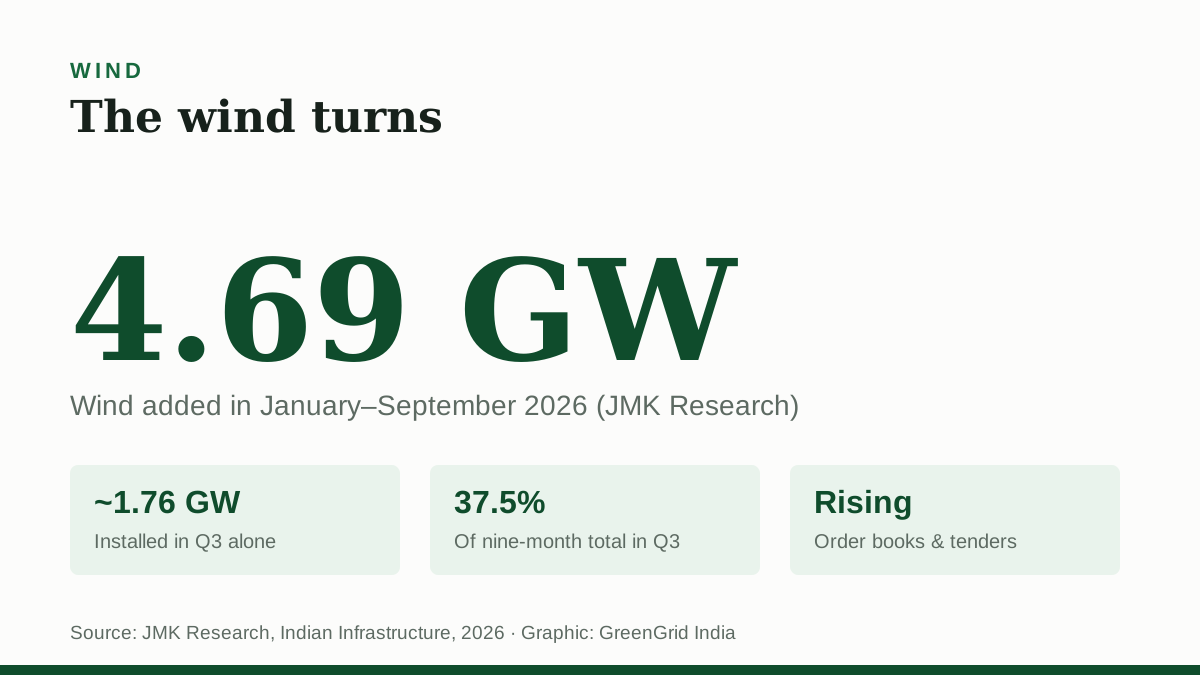
According to JMK Research, India added about 4.69 GW of wind in the first nine months of 2026, with roughly 1.76 GW — about 37.5% of the total — coming in the third quarter alone. That sequential pickup matters: it suggests the pipeline is converting after a sluggish start to the year, a pattern trade analysts at Indian Infrastructure have described as a genuine revival rather than a blip.
What’s pulling wind back
Several forces are working in wind’s favour:
- Hybrid and round-the-clock tenders. As auctions increasingly bundle solar, wind and storage to deliver firmer power, wind’s complementary generation profile — stronger in the evenings and through the monsoon, when solar fades — is back in demand.
- Bigger, better turbines. Larger rotors and taller towers have improved capacity factors at India’s moderate-wind sites, improving project economics.
- Policy and repowering. State-level support and interest in repowering older, under-performing wind farms with modern machines are adding to the order book.
Keeping perspective
The comeback is real but modest. Wind’s roughly 4.69 GW over nine months is a fraction of the 35 GW of solar added in the same period, and the sector still faces land, transmission and turbine-supply constraints. Wind is unlikely to rival solar on sheer volume.
But a grid leaning ever harder on variable solar needs wind’s different rhythm — and for the first time in a while, the turbines are turning in the sector’s favour.
This article is based on data from JMK Research and analysis published by Indian Infrastructure.