India has some of Asia’s best offshore wind resources and, so far, not a single large offshore turbine in the water. The government is trying to change that — again.
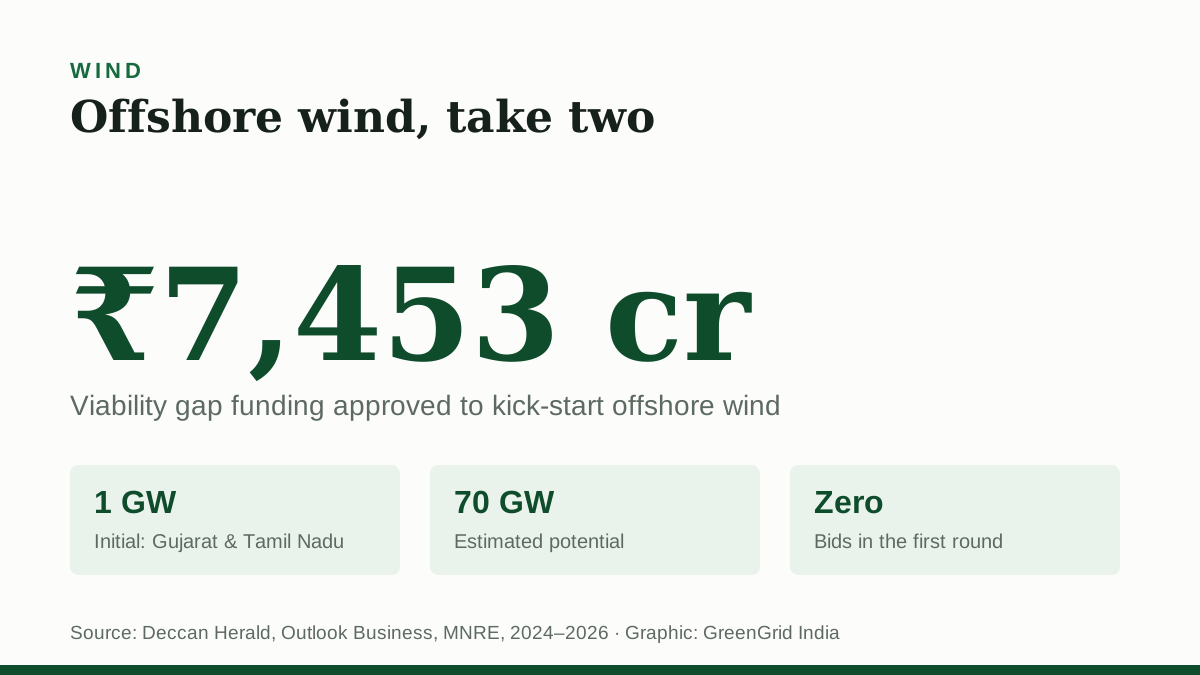
The Union Cabinet approved a viability gap funding (VGF) scheme worth ₹7,453 crore to kick-start offshore wind, with roughly ₹6,853 crore earmarked for an initial 1 GW — split as 500 MW each off Gujarat and Tamil Nadu — and about ₹600 crore for upgrading two ports. MNRE sets policy while SECI runs the bids and disburses funds.
A false start
The first attempt failed outright. SECI cancelled offshore tenders totalling some 4.5 GW in 2025 — a 500 MW Gujarat project and a 4,000 MW Tamil Nadu seabed allocation — after no bids arrived despite repeated deadline extensions. Developers balked at the economics: offshore wind in India would need tariffs far above the roughly ₹4–4.5/kWh grid-scale benchmark, with reported ceilings around ₹10.50/kWh for Gujarat and ₹9.60/kWh for Tamil Nadu. Without firm offtake and risk-sharing, the numbers simply did not close.
Why persist
The prize is large. MNRE estimates around 70 GW of offshore wind potential across Gujarat and Tamil Nadu, and a floating-LiDAR survey by the National Institute of Wind Energy found capacity utilisation factors of 45–50% off Tamil Nadu — far above typical onshore sites and well ahead of Gujarat’s ~37%. Offshore wind also generates more steadily and into the evening, complementing solar’s midday peak.
The VGF scheme is designed to bridge exactly the gap that sank the first round, buying down cost so early projects can be financed. Whether it is enough — and whether the relaunched tenders actually attract bids this time — is the question the next year will answer.
This article is based on government announcements and public reporting; the status of the relaunched tenders continues to evolve.